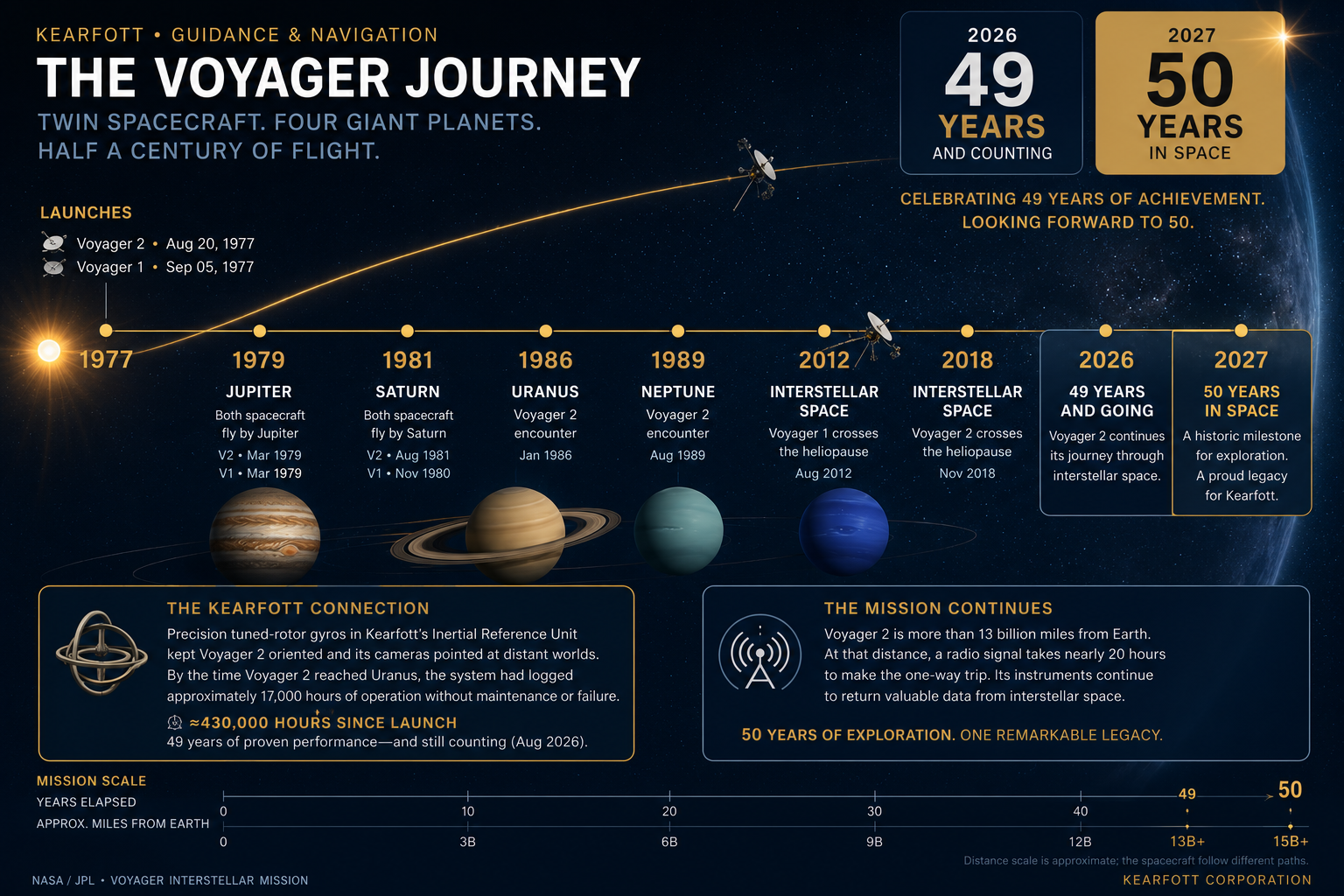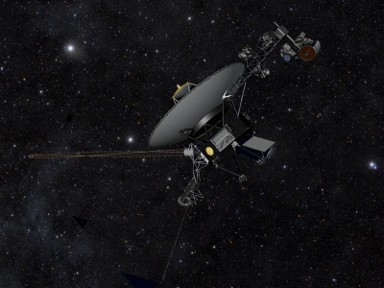
An artist’s concept of NASA’s Voyager spacecraft. Voyager 2 launched on August 20, 1977, and continues its mission in interstellar space. Credit: NASA/JPL-Caltech.
Forty-nine years after leaving Earth, NASA’s Voyager 2 is still going. The spacecraft is now traveling through interstellar space, more than 13 billion miles from Earth.
There is also a Kearfott connection to its remarkable story. Kearfott technology helped Voyager 2 maintain its orientation and point its cameras as it explored the outer planets.
Voyager 2 launched on August 20, 1977. It flew past Jupiter in 1979 and Saturn in 1981 before continuing on to Uranus in 1986 and Neptune in 1989. It remains the only spacecraft to visit all four of the solar system’s giant planets at close range, and the only one ever to visit Uranus and Neptune.
Voyager 2 carries a Kearfott Inertial Reference Unit that uses precision tuned-rotor gyroscopes to provide an inertial reference for attitude control. The gyroscopes provide a stable reference for sensing changes in the spacecraft’s direction. The system also helped Voyager 2 point its cameras at planets and moons and hold them steady while taking photographs. The most critical function of the inertial reference is keeping Voyager 2’s X-band high-gain antenna pointed toward Earth so the spacecraft can send data and receive command and control signals.
By the time Voyager 2 reached Uranus in January 1986, Kearfott reported that the system had logged approximately 17,000 hours of operation without maintenance or failure.
Voyager 2’s encounter with Uranus gave scientists their first close-range look at the planet. The spacecraft discovered 10 new moons and two new rings during the encounter. Three years later, Voyager 2 reached Neptune, where it discovered new moons and rings and observed the Great Dark Spot. No spacecraft has visited either planet since.
And Voyager 2 kept going.
In 2018, it crossed the heliopause and entered interstellar space. Today, Voyager 2 is approximately 13.3 billion miles from Earth. At that distance, a radio signal traveling at the speed of light takes nearly 20 hours to make the one-way trip between Earth and the spacecraft.
Keeping Voyager 2 operating after nearly five decades presents its own engineering challenges. Its available electrical power declines by about four watts each year, so NASA engineers carefully manage what remains. In August 2026, engineers freed additional power aboard Voyager 2, helping extend the operating life of its three remaining science instruments as they continue collecting data from interstellar space.
Voyager 2 has traveled for 49 years, visited four giant planets and ventured far beyond its original planetary mission. Its journey is also a remarkable piece of Kearfott history.